Home
About Ecuador
CUENCA Banking
Cuenca
Cuenca Condos
Cuenca DVD
Cuenca Hotels
Cuenca Properties
Cuenca Q & A
Cuenca Real Estate
Cuenca Rentals
Christmas/Cuenca
Consulates Abroad
Dentist
Expat Classifieds
Expat Services
Ecuador Stories
E Vega Galeria
Health Care
Import/Export
Know Cuenca Tour
Move to Ecuador
Relocation Services
Restaurants
Retire to Cuenca
Residency Info
Seminars
Vazcorp
QUITO Experience Ecuador
ECUADOR TOURS Tours
Jungle Tour
OTHER CITIES TO VISIT Otavalo
Galapagos
Quito
Other Cities
ECUADOR INFO Doing biz in Ecuador
Ecuador Articles
Expat Books
Ecuador Legal System
Learn Spanish
More Information
Tips for Ecuador
CONTACTS Advertise with RIE
Books/DVD's
Contact RIE
Ecuador Blog
How I built this site
Links
Photos
Privacy Policy
Testimonials
Subscribe to RIE
Video Gallery

Subscribe To This Site
XML RSS
Add to Google
Add to My Yahoo!
Add to My MSN
Subscribe with Bloglines
 

Trip to the Jungle

Custom Search

July 2010

Hola Everyone,

We finally got around to visiting the jungle for the first time. Our primary destination was Macas, about a 5-hour drive from Cuenca. I it mainly takes this long because the roads are in poor condition for a good portion. Our good friend and driver Juan took us, and two new friends, Dave and Karen. Juan said that the roads should be completely upgraded within two years, and the journey will take a lot less time.

To give you an idea where Macas is in relation to Cuenca,the following Maps should help. Cuenca is the capital of Azuay.

There are two main routes from Cuenca to Macas. We decided that we would travel one way, driving past the hydro electric schemes which is in the direction of a town named Paute, and then return the other way via Gualaceo which is shorter, but takes longer due to the poor condition of the roads. The blue arrows in the above map shows the two different routes. You can also see that there are not any major roads marked. We essentially have to get from the Pan American Highway #35 across and down the mountains to highway #45.

Not far out of Cuenca we came across the hydro electricity schemes. There are three on this river system that comes from Cuenca. This one shown below is the largest. About 63% of Ecuador’s energy is filled by hydroelectricity. Ecuador exports surplus power to neighboring countries during peak rainfall periods, but also imports power during dry periods.

We drove straight through Macas because it was getting late in the afternoon. We wanted to be able to see a property about 45 minutes north of Macas. This photo below is of Highway #45 – from Macas to Puyo. The entrance to the hosteria we will stay at is on the left.

After we turn off the highway to drive to the property, we passed an attractive new cottage that is completely made from local timber.

This is a typical arterial road in the jungle, although many are in poor condition due to lack of maintenance. With an annual rainfall of about 100 inches (2,500 mm), it is little wonder that the roads deteriorate.

The entrance to the property we came to look at as potential for agroforestry is somewhat boggy. A road of about 500 meters from the local village to the property boundary needs to be constructed.

We arrived back at the hosteria before sunset. It is beautifully constructed and finished.

On one side of our bedroom was a view to the swimming pool.On the other side was a hammock.

And the gardens were also well suited to the area.

From the boundary of the hosteria we could just make out the Sangay Volcano, which along with two other volcanoes are located in the Sangay National Park. The volcano has an altitude of about 5,230 meters (approx 17,000 feet). Although it looks close, it takes about 7 days to hike through the National Park to get to it. This is the seventh largest volcano in Ecuador and it is probably one of the most active volcanoes in the world. Residents of the city of Macas are able to enjoy this fearful sight from their city - though they are situated relatively far from it. At night the volcano emits a gentle halo of light as the lava inside the crater continues to bubble at excessive heats.

This first photo is ours. We could just see it through the clouds from the hosteria. Apparently we were fortunate for this time of the year.

On clear days, Volcano Sangay (5230m) can be seen from Macas towering over the jungle landscape with a thin whisper of smoke trailing from its picturesque, snow-capped cone. "Sangay" means "Peaceful One" in the native Shuar language - an appropriate name for the passive eruptive quality of one of the most continuously active volcanoes in the world.

This is a photo of the Upano River – looking from the hosteria. The National Park is on the other side of the river.

And from the bridge.

For those interested in rafting, Macas is a comfortable place to base from for running the Upano River, which is one of the few multi-day rafting trips in Ecuador. The Upano is the longest river in Ecuador.You can take flights from Quito, or have a long drive. Alternatively drive or take a bus from Cuenca. Within a couple of years, that will be a reasonably comfortable option - although still a very winding road through the mountains.

The Upano River is usually offered as a 5-6 day rafting itinerary which includes camping, whitewater rafting, and cultural interactions with local Shuar communities. From Macas, the river starts off by coursing through braided, island channels with smaller rapids until entering the Namangoza Gorge just below "Patuca". This beautiful, waterfall-lined canyon has "big-water" waves and features and should only be entered at moderate water levels.

Juan Heredia from TerraDiversa offers a 4 day rafting tour down the Upano river. See    

http://www.terradiversa.com/adv/raft_adv.html

Also see http://www.ecuadoradventure.ec/html/tropical_rafting_sacred_waterfalls.htmlfor a 5-day rafting experience on the Upano River. Check http://ecuaworld.com/rafting/upano.htmtoo.

This photo below is of our friend and driver (Juan) and us.Juan would like to do more of these sorts of tours and wants to upgrade to a minivan. I will keep you posted if and when this happens. He also wants to do shopping tours to Guayaquil, with me as a guide.

We finally settled down for a drink and dinner. The food was superb. We rarely eat red meat, but we all wanted to try the local steak. It was the best we have had anywhere in the world. It must be all the fresh grass that the cows eat all year round!

Next morning Juan introduced us to his niece, Gabby, who is a dentist in Macas. Gabby told us about trips she takes by small aircraft to the jungle to provide dental services to the indigenous Shuar people. The next time we see her she is going to show us her photos of the jungle that were taken from the air.

After breakfast, Juan took us for a tour of Macas(approximately 30,000 people). It reminded us of our own country towns in Australia, with wide clean streets – a lot different to many smaller villages we have seen in Ecuador.

The town of Macas was once known as “Sevilla del Ora” which,when translated, means “Golden Seville”. This historical town began its humble beginnings as a Missionary Outpost formed by the Dominican Church shortly after the Spanish conquest in 1533. This thriving centre also became a formidable Spanish trading post during its early stages of its history.

Later Macas became a founding centre of great affluence and prosperity that was created by the surrounding gold mines in this particular area. Unfortunately this came to an abrupt end due to the many violent attacks on the town in conjunction with the mines. In turn, with the mines abandoned for the safety of those inhabiting the area, Macas began to deteriorate.

Today Macas, the capital of Morona-Santiago Province, has developed an important role in the development and commercial sector. It has increased in tourism since the 1998 treaty between Macas and Peru. Even with all these developments and advances, the area is still very well protected by the local Shuar and Achuar people. Attempts to ensure the preservation of this natural habitat has seen action taken against companies that wished to take unfair advantage of the virgin lands - such as petroleum companies. Such efforts have brought great advantages to the town and seen to the continued survival of over 400 years of its history.

We finally left the area and headed back to Cuenca, in order to arrive before nightfall. Juan advised us that the roads via the return route were treacherous. We sound found out why.

The views however were spectacular. The rainforest was evident everywhere as we climbed from Macas. And the drops to rivers,waterfalls and ravines made us glad that we were traveling in daylight.

As we came within 90 minutes of Cuenca, we passed road construction – to widen the road to be safer. It still looked like it was going to be dangerous unless guard rails were erected.

Can you see the excavator working in the photo below? It is pushing dirt over the edge of the road into the ravine below. That is also the road that we drive on. Anyone scared of heights?

As we came within 90 minutes of Cuenca, the cleared land for pastures was noticeable.

It was a great adventure. I was a little surprised at not seeing any "wild animals" even though I would probably have freaked out a little. There was one little furry creature lurking in the gardens of the Hosteria see below.

I hope you have enjoyed reading about our trip to the jungle, one we would definitely recommend.

Until I write again.

Chao for now

Dixie


Subscribe for your FREE Newsletter

Enter your E-mail Address

Enter your First Name

Then

Don't worry -- your e-mail address is totally secure.
I promise to use it only to send you Retire in Ecuador.

Free Spanish Lessons


Cuenca DVD - Produced by Michael Karsh


Living and Retiring in Cuenca Questions and Answers

Can’t see your question then ask us.

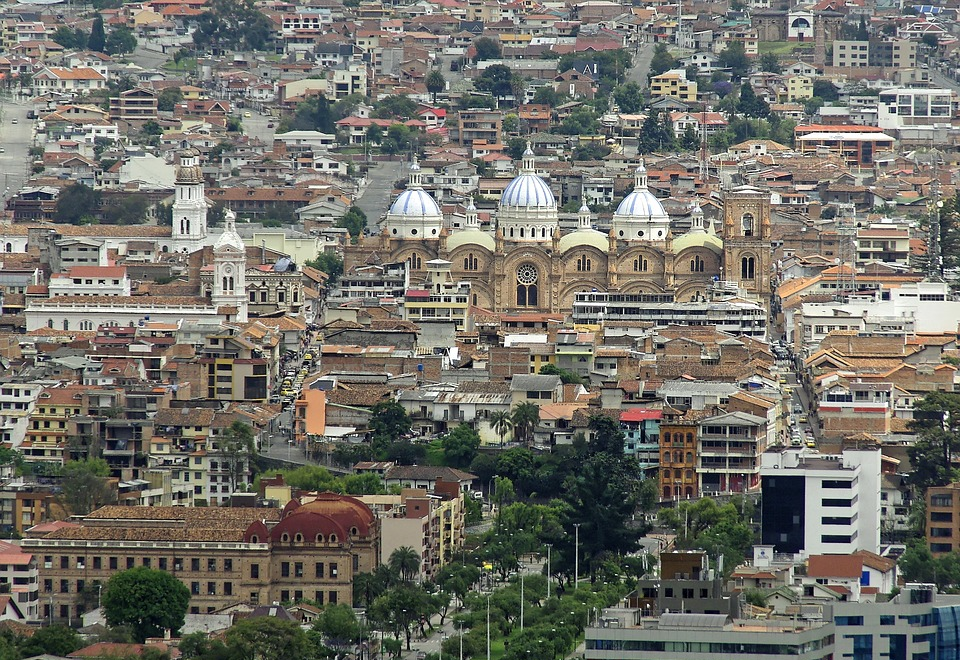
New Cathederal Cuenca